Anyone can generate text. I answer for every claim.
A Gartner survey of 1,006 US consumers, published on 22 September 2026, found that 57% say AI-generated content has made them less trusting of brand messaging. I check machine-drafted copy against its sources before it ships, and every check on this page is yours to run.
I write web and PR copy, bids, case studies, UX microcopy, and board speeches for B2B, B2C, and B2G teams, including regulated industries, where every claim has to hold.
Four retained accounts, with clients in the UK, the US, and Malta. The professional-range copy written by hand at BRITA is still live.
Test three How it checks
Find the error
Checking means finding the claim that does not hold, so here is a paragraph with three of them.
The paragraph is about the Gordon Murray Automotive T.33 Spider and uses only claims named in the evidence ledger on its concept page; three were held back or corrected there. Mark the phrases you doubt, then press Check to see how many errors you found and how many false alarms you raised. Each answer links to its pin in the evidence viewer.
This paragraph contains three deliberate errors.
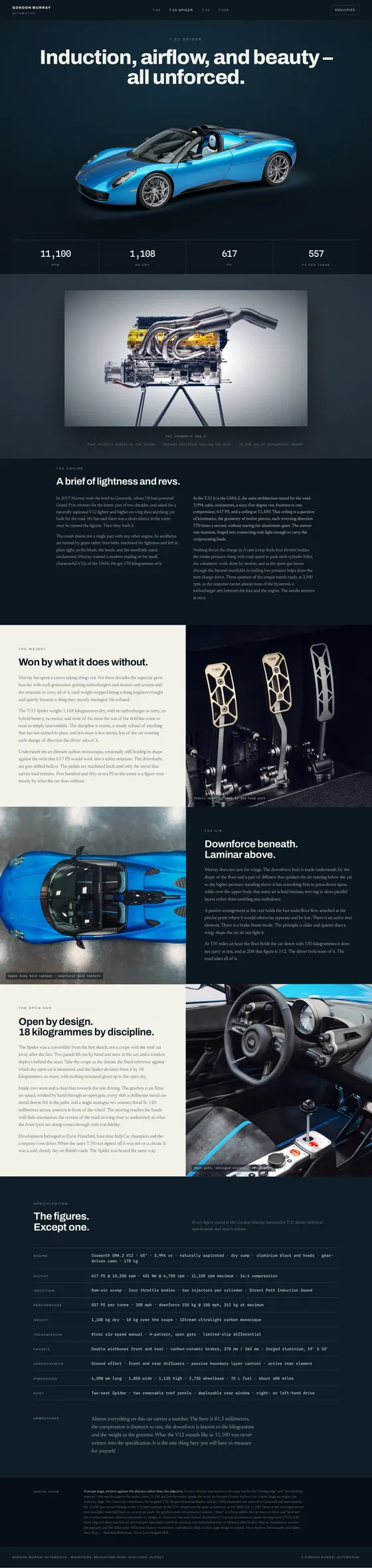
Gordon Murray Automotive took the T.33 Spider’s brief to Cosworth, and the result is a bespoke V12 with gear-driven ancillaries, built in the spirit of 1960s V12 engines. The Cosworth GMA.2 revs to 12,100 revolutions per minute. The structure is a carbon laminate, and the laminate is isotropic. The downforce is made underneath. It comes from shear at the front splitter.
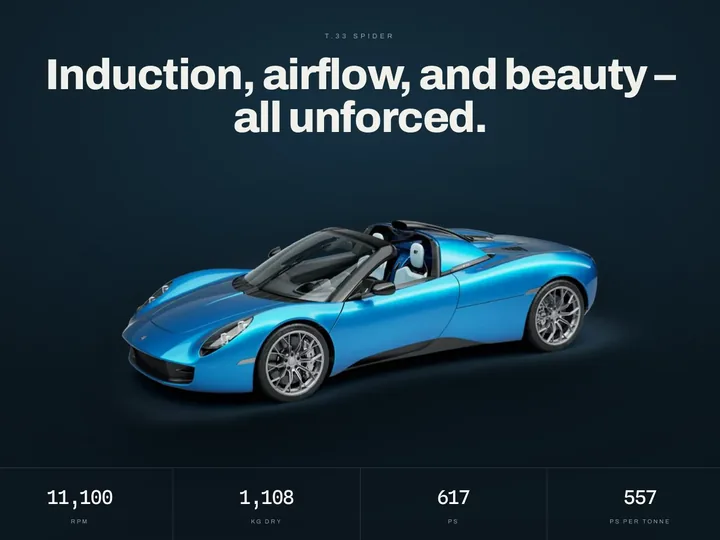
Each of the three was held back or corrected on the T.33 Spider concept page. See them in place, beside their notes.
The three answers
- revs to 12,100 revolutions per minute. The 12,100 rpm record belongs to the T.50 and was kept off the T.33, whose Cosworth GMA.2 V12 is limited to 11,100.
- is isotropic. “Isotropic” was held back for a carbon laminate, which is anisotropic by design, so “torsional” was used instead.
- shear at the front splitter. “Shear” at a front splitter was held back on veracity grounds: the car does not have one.
Why the checking matters: four problems with AI-drafted content
The figures and their sources
The premise: most new web pages now carry AI-written text
Ahrefs ran its own detector over 900,000 pages its crawler first found in April 2025, one page from each site. About three in four contained AI-generated text, and most of those mixed it with human writing. The figures are one detector’s estimates, not proof of who wrote any given page.
900,000 new pages, by how much of the text was AI-generated
Readers distrust it, and cannot reliably spot it
The first grid is Gartner’s release of 22 September 2026, a survey of 1,006 US consumers. Bynder’s 2024 survey of 2,000 UK and US consumers put two articles side by side, one written by an LLM and one by a trained copywriter (the second and third grids). The fourth is Gartner’s release of 16 March 2026. Each grid is 100 people, scaled from the survey percentages.
It says what is not so
About 1 in 4
Answers the median model invented to questions about things a document never mentions, at a 32K context
A 2026 preprint tested 35 open-weight models with questions the source cannot answer. The best invented an answer 1.19% of the time at 32K, and 10.25% at 200K. The longer the source, the more closely a draft needs checking.
It gets accused, and the detectors disagree
AI detectors disagree: the Authors Guild ran five detectors on ten human-written articles from 2022 or earlier. One detector’s score is weak evidence on its own.
It may need a label
Since 2 Aug 2026
The EU AI Act requires a clear label on AI-generated text published to inform the public on matters of public interest, unless it has undergone human review or editorial control and a person or company holds editorial responsibility for the publication. Scope is a question for legal advisers.
How I check machine-drafted copy before it ships
The CV sets out the record. This page lets you see and test the method behind it.
The method in five steps: you send the source, a model drafts from it, I check every claim against that source, I read the draft for machine phrasing, and you get the finished piece with its production notes. Below, you can watch it work on three real products, then try three tests and two tools.
How a piece reaches you
Five steps, taken in order, and a written record at the end.
The chips follow one claim from the T.33 concept page. An example, not client work.
You send the source
Specifications, standards, product sheets, contract small print: whatever your claims rest on.
Source: limited to 11,100 rpm
A model drafts
It drafts from that material, in your voice, and the draft counts as unchecked until step three.
Draft: revs to 12,100 rpm
I check every claim
Each one goes back to its source. What I cannot source is flagged, corrected, or held back, and never invented.
Flagged: 12,100 is the T.50 record
I read it for tells
I rewrite machine phrasing and flat rhythm, and then every claim gets its second check.
Checked again: a ceiling at 11,100
You get the record
The finished piece arrives with its production notes: what was checked, what was held back, and why. You sign it off.
Recorded: 12,100 held back
Check a signed-off text
Every piece I deliver carries a fingerprint in its production record, so you can prove later that the text you hold is the text I signed off.
Paste a text I delivered and the fingerprint from its production record. Your browser does the computing, and nothing leaves it.
This text’s fingerprint:
A match proves the text is unchanged. It says nothing about who wrote it.
Test two How it reads
How a sentence lands
Why some sentences stick and others slide past, measured as you read.
English saves its heaviest information for the end of a sentence; grammarians call it end focus. Whatever sits in the final seat is what the reader keeps, so I give that seat to the fact, and cut any clause that would steal it. In the large headings on this page, the weight builds towards the words where each sentence lands.
Across a paragraph, sentences hold a reader when their lengths vary, long against short. Two numbers measure it: spread, how far the lengths vary, and clumping, whether similar lengths travel together or alternate.
Both are composition standards. No score here, or anywhere else, settles who or what wrote a text.
Sources
End focus: Quirk, Greenbaum, Leech, and Svartvik, A Comprehensive Grammar of the English Language (1985). The structural check simplifies Joachim Lambek, “The Mathematics of Sentence Structure”, The American Mathematical Monthly 65(3), 1958, pp. 154–170.
Rhythm reference: Abraham Lincoln, Second Inaugural Address, 4 March 1865, from the Avalon Project at Yale Law School. Sentence splitting is heuristic.
Wide spread, and long and short alternate. Short sentences, eight words or fewer, show in red. For reference, Lincoln reads 0.74 and 0.18.
In detail: how grammar decides the last word
Lambek gives every word a type. A name is n and a sentence is s. An intransitive verb such as works is n\s: it takes a name on its left and returns a sentence. Two rules do the cancelling. A type x/y followed by y gives x; a y followed by y\x gives x.
Final: the payload cancels last
Draft: the tail cancels after the sentence is complete
The final seat belongs to whatever cancels last on the right. In the draft, the sentence was already complete at “ring”, so the trailing clause cancels against a finished s and takes the beat. Lambek called his own assignment of types “tentative”, and these are a working simplification in the same spirit. He withholds n from pronouns, so the n on “It” is ours.
In detail: how the two rhythm scores are calculated
For sentence lengths x₁ … xₙ with mean μ and population standard deviation σ:
Clumping is the lag-1 autocorrelation. Negative values mean long sentences tend to follow short ones, and positive values mean similar lengths travel in packs.
Test one How it reads
One pitch, written two ways
Copy with one rhythm and the same stock phrases sounds like every competitor’s page, and a buyer has little reason to keep reading.
Each struck-through phrase is a tell, counted live.
Before: a typical AI-style pitch, written by me as a sample
4 tells, 40 words
I’m a results-driven content strategist with a passion for crafting compelling narratives that resonate with target audiences. With a proven track record across diverse industries, I leverage data-driven insights to deliver impactful content that drives engagement and elevates brand visibility.
Written for anyone. Four tells from the house list, two long sentences in a row, and not one claim a reader could check. The list counts machine vocabulary, not every CV cliché: “proven track record” passes the scanner and still fails the reader.
After: checked, for marketing leaders
0 tells, 42 words
Drafts now arrive faster than anyone can check them. Each one ships under your name. I rewrite machine-drafted copy against your house standards: every claim traces to a source, every market hears one brand. Four retained accounts are held to that standard.
Written for marketing leaders. It opens on their problem, and two short lines land the point before the detail.
Why each line changed
Drafts now arrive faster than anyone can check them. Each one ships under your name.
Register Opens on the problem the reader owns, in the reader’s terms. Rhythm A short line after a longer one.I rewrite machine-drafted copy against your house standards.
Claim Names the service and the yardstick where the Before names a trait.every claim traces to a source, every market hears one brand.
Claim Two checkable promises replace “proven track record”.Four retained accounts are held to that standard.
Claim A count the reader can query replaces “diverse industries”.
Now try your own copy.
Three samples, three sectors
One method, three kinds of reader. Each sample is a full piece for a real brand, in that brand’s own voice: every figure traced, every claim pinned to the note that backs it.
Speculative concepts, made as testbeds for the method. None was commissioned by, or is affiliated with, the brand it features.
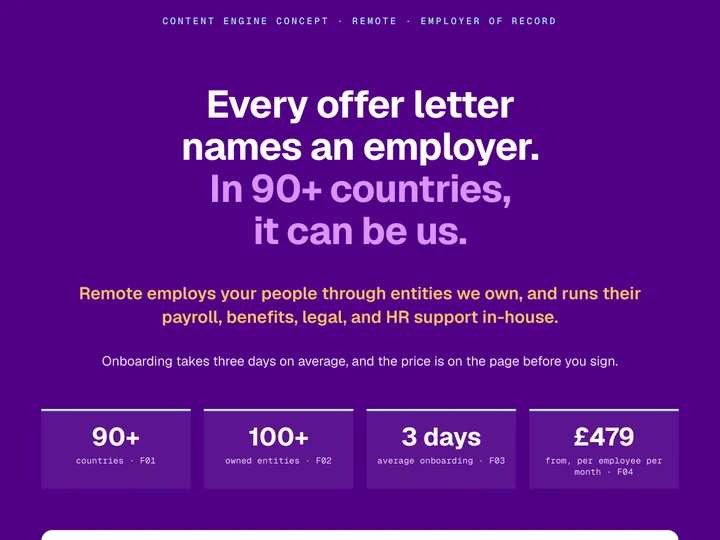

Two entries from its ledger
- Flagged “FAQ quotes a price no card carries”
The price cards agree in all 24 markets. The FAQ answer contradicts its card in 10 of the 22 that quote one.
- Corrected “every fact right and the voice wrong”
The previous draft used no contractions. Remote’s own pages were measured first, and the copy follows them.
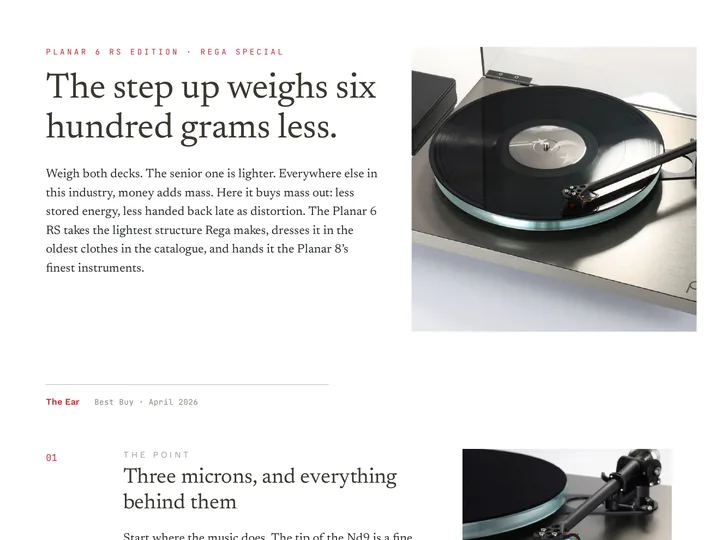

Two entries from its ledger
- Verified “Which prices the RB880 at twenty-five pounds”
£2,000 complete, less £1,280 for a standard Planar 6 and £695 for the Nd9, as The Ear reported in April 2026. The review itself puts the arm at £25 in the package.
- Held back “Not published. Still.”
Rega publishes no wow and flutter or rumble figures, so none is borrowed.
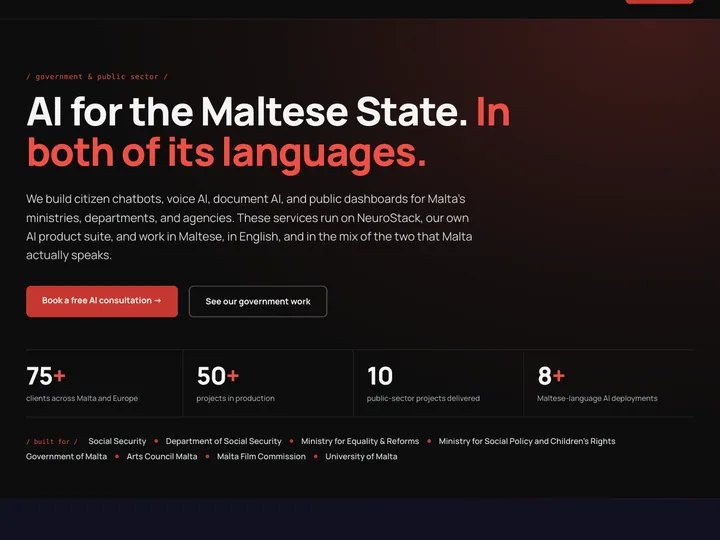

Two entries from its ledger
- Corrected “Maltese makes up 0.0032%”
neuromaltese.mt gives 0.03%. The crawl itself publishes 0.0032%, so the page uses the published figure.
- Counted “Ten projects for the Maltese public sector since 2024”
The count of published government case studies. The true number may be higher.
The worked example
Test three below is built from this page’s ledger, and Lexiphon quotes it as a brief.
Two entries from its ledger
- Held back “The gearbox is an Xtrac six-speed”
The gearbox is named without its mass. The gearbox mass, an unsourced number, was held back on veracity grounds.
- Verified “Every figure traced to the Gordon Murray Automotive T.33 Spider technical specification and launch release”
The figures. Except one: what the V12 sounds like at 11,100 was never written into the specification.
The full record
Eight entries from the ledgers sit on the cards, two on each. The four documents carry 37 in all.
What does your company sound like?
A company can say what it aspires to be, or which problem it solves: that is its purpose, and tone of voice is how it sounds when it speaks. I designed Lexiphon to put that sound on the page, where you can see it and change it. Bring a paragraph you are proud of, or one you suspect sounds like everyone else’s.
Studio A tone-of-voice tool
Lexiphon
Lexiphon is a browser tool for tone of voice: you pick a voice, watch the same facts change character, and check a pasted draft against it. It runs on rules in the page, calls no language model, and sends nothing you type anywhere.
Adjust the voice
How to read it
The four tone dimensions are the Nielsen Norman Group’s (2016). The twelve archetypes come from Margaret Mark and Carol S. Pearson, The Hero and the Outlaw (2001); where each sits on the four dials is my reading, and so is every rule that turns tone into structure. Two briefs are invented, as each one says. The other two quote real pages: the concept page for the Gordon Murray Automotive T.33 Spider, and this site. Checking a draft, Lexiphon can measure formality and enthusiasm by proxy, sentence lengths, point of view, and figures that need a source. It cannot measure humour or respect, or tell whether a claim is true.
Telltale
Telltale is a browser tool that marks every phrase from my house list of machine-sounding copy in text you paste, in three groups: rewrite on sight, needs a reason, and structural pattern.
Some words turn up in machine-written text far more often than in human writing, and people who use chat models have learnt to spot them.
The test runs my own house list, which is growing: 135 words and phrases to rewrite on sight, 68 that need a reason, and 14 structural patterns. It began with the words named in published research and in the guide Wikipedia’s editors keep on signs of AI writing.
A hit is a register problem. It is never proof of authorship: several of these words were already rising in academic prose before chat models arrived. Structure beyond these patterns still needs a human reader.
Sources
Kobak, González-Márquez, Horvát, and Lause, “Delving into LLM-assisted writing in biomedical publications through excess vocabulary”, Science Advances 11, eadt3813 (2025).
Russell, Karpinska, and Iyyer, “People who frequently use ChatGPT for writing tasks are accurate and robust detectors of AI-generated text”, ACL 2025.
Matsui, “Delving Into PubMed Records”, Perspectives on Medical Education 14(1), 2025.
Wikipedia, “Signs of AI writing”, consulted 23 September 2026.
Open Telltale
Test any text with Telltale
Paste a bio, a job advert, or a draft of your own. The test marks every tell it recognises as you type, and nothing you enter leaves your browser.
Rewrite on sight Needs a reason Structural pattern Hover over a mark to see its entry.
What I do
AI editing and governance
- Your machine-drafted copy comes back rewritten against my written house standard, which you can test.
- Retrieval-augmented generation starts with your material, loaded with your permission, so each answer cites its source passage.
- I build pages for retrieval in search, AI answer boxes, and generative engines: attribution at the start of the sentence, the subject named in full, and each section able to stand alone. A report follows on what changed and what your own analytics showed.
- This site is built that way. Its structured data, plain-text copies for language models, and search descriptions all come from one source, and the build stops if a summary cites words the page no longer carries.
Writing and editing
- I write for B2B, B2C, and B2G teams, check every claim against your documents, and hold house style on every agency account.
- That includes UX and UI microcopy, bids, case studies, and board speeches.
- Brand archetype sets the tone of voice, and I run A/B testing and content performance reviews.
- Every content type draws on one fact base, verified once against source. In a content engine for Remote’s Employer of Record, one checked record fed eight surfaces: a blog article, a sales leave-behind, a lifecycle email, answer blocks for AI search, an FAQ, campaign lines, German-to-English transcreation, and a motion brief.
Tools and training data
- Drafting runs through tools I have set up, and nothing ships until it has passed them and my own eye.
- At micro1, I review and annotate robotic-arm video against customer grading guidelines: training data for frontier AI labs.
Who is behind the checks
Checking sources came before writing in my training, and it still comes first in my work.
Someone has to be sure that every sentence is true before it goes out, and I like being that person, the last reader before the buyer. The work lives in specifications, standards, and contract small print, the dense documents that regulated industries run on, line after line. Every line reaches a buyer. That buyer reads the English and believes it, so every figure is checked against its clause before it reaches them. Every decimal against the standard that set it. Every sentence against the page. Nothing goes out on faith, and what goes out is English a buyer can trust.
What the checking rests on
A model can compare a sentence with a source. It cannot know which sentence the reader will test first, or what the source leaves unsaid. Three kinds of experience tell me where to look.
Standards-bound writing
At BRITA I wrote the master content for a water-filtration range in a standards-bound industry. That taught me which claims a specification can carry, and which it cannot.
Reading technical documents
At CM-AG I drafted a US patent application, published as US 2008/0046327 A1. Every word in a claim bears weight.
Grading against a rubric
At micro1, my annotations are peer reviewed, and I review my peers’ in turn.
The record: experience, published work, clients, and sectors
The page shows the method.
The work carries my name.
If you are hiring, send me the role, and I will answer with the work that fits it best.
One email is enough, and I reply within one working day.